Coops & Housing
How Much Outdoor Run Space Chickens Need Beyond the Coop Itself
Chicken run size depends on whether birds free-range or stay confined. Get per-bird ranges, a simple sizing method, and fencing tips that stop predators.
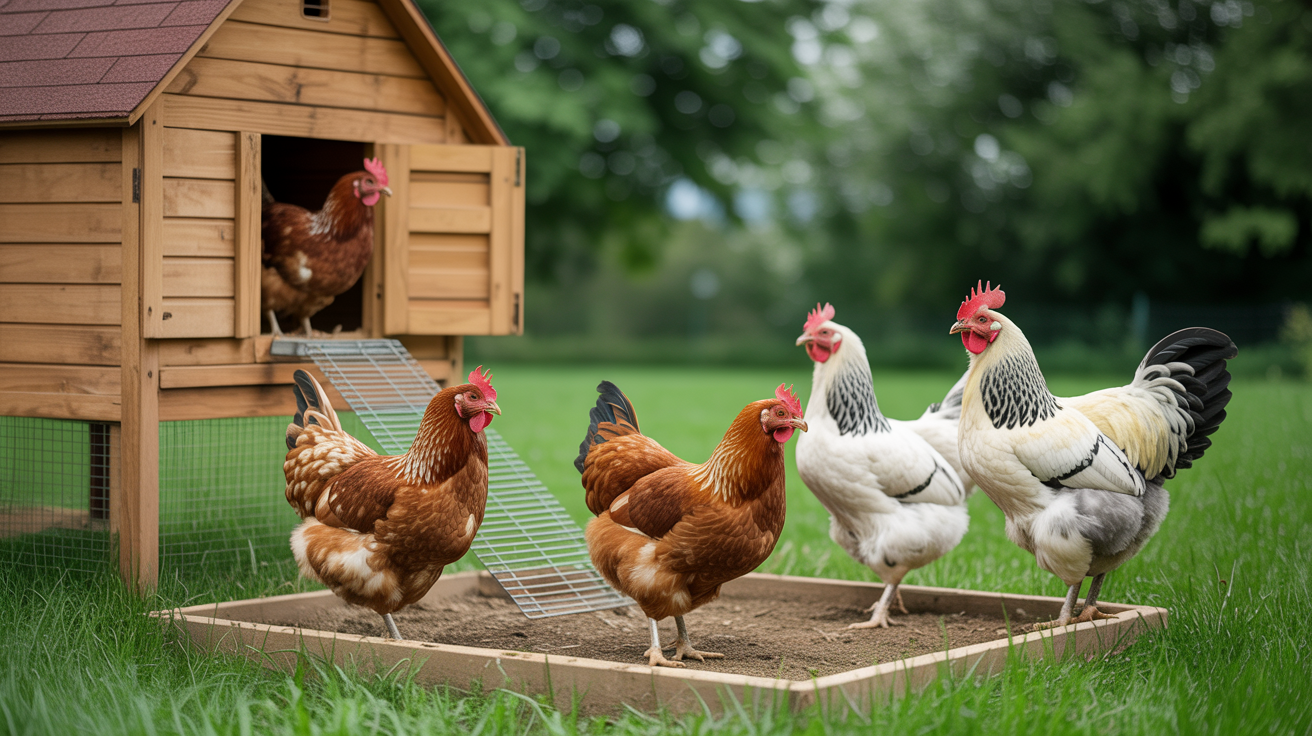
You've got the coop interior sorted, roost bars up, nest boxes in place, and now you're staring at the empty patch of yard where the run needs to go. Chicken run size is where a lot of new keepers underbuild, because the coop numbers get all the attention and the run gets whatever space is left over. That's backwards. Your birds will spend far more waking hours in the run than inside the coop, so skimping here shows up fast in flock behavior.
The run is where chickens dust bathe, forage, chase bugs, and work out their pecking order without a roof six inches over their heads. Get the square footage wrong and you'll see it in feather condition and flock tension before you see it anywhere else.
Getting Chicken Run Size Right: The Basic Ranges
The commonly cited range for a fully confined run, meaning birds that never get supervised free-range time, sits at roughly 8 to 10 square feet of run space per standard-size bird. That's on top of the 3 to 4 square feet per bird inside the coop itself, not instead of it. Bantams can get by with somewhat less, maybe 4 to 6 square feet each, since they're smaller and less territorial about ground space.
If your flock gets regular free-range time, even just an hour or two of supervised roaming in the evening or on weekends, you can often get away with less dedicated run space, down to 4 to 5 square feet per bird, because the run isn't the only outlet for their energy and foraging instinct. The tradeoff: less run space means more dependence on you remembering to let them out, and more exposure during the hours they're loose. For the full picture on balancing those two, see free-ranging chickens.
These are ranges, not laws of physics. Breed temperament matters too. A run stocked with calm, heavy breeds tolerates tighter quarters better than one full of flighty, high-energy layers who want to move.
Confined Run vs Some Free-Range Time: Why the Gap Matters
The difference between a fully confined setup and one with free-range time isn't just about square footage on paper, it's about what the birds do with their day. A flock that never leaves the run relies on that space for everything: dust bathing, scratching, sunning, working through boredom. Cram too many birds into too little ground and you're asking that same patch of dirt to absorb all of it, all day, every day.
A flock with free-range time spreads that activity across a much bigger area for part of the day, which takes real pressure off the run. That's why the lower end of the per-bird range works for free-rangers but would be a mistake for a fully confined flock. If you're not sure yet whether free-ranging will be part of your routine, size for the confined-run numbers. It's easier to have space you don't strictly need than to expand a run later around an existing coop, fence line, and garden bed.
What Happens When the Run Is Too Small
A cramped run doesn't just look crowded, it changes how your birds treat each other. Every flock has a pecking order, and that hierarchy gets enforced through small physical cues: a peck, a shoulder-check, a bird stepping aside. In a run with enough room, subordinate birds can simply walk away and put distance between themselves and a more dominant hen. In a tight run, there's nowhere to go.
That lack of escape room is a big driver of feather picking and outright bullying. In a stressed, overcrowded flock you'll often see one or two birds losing feathers around the tail and back, not from molting but from repeated pecking they can't get away from. Crowding stress can also show up as more squabbling at the feeder or hens going broody or stopping lay for no obvious seasonal reason.
Feather loss and aggression have several possible causes, including mites, poor nutrition, or too few feeder and waterer stations for the flock size. Crowding is one common cause among several, so if you're already at a generous square footage and still seeing picking, look at those other angles too.
A Simple Way to Size Your Run
You don't need a spreadsheet for this. Pick your flock size, decide honestly whether free-ranging will happen regularly or only occasionally, and multiply.
- Count your birds, including any chicks you plan to add within the next year, since a run built for today's flock of four is undersized the moment you add three more pullets next spring.
- Choose your per-bird number: 8 to 10 square feet per standard bird if the run is the only outdoor space they'll ever get, or 4 to 5 square feet per bird if free-ranging happens most days.
- Multiply bird count by per-bird square footage. Six standard hens in a fully confined run lands you at 48 to 60 square feet, roughly a 6 by 9 or 8 by 7 footprint depending on your yard's shape.
- Round up, not down. A feeder station, a dust bath area, and a shaded corner all eat into usable floor space without adding to your bird count.
- Build in room to grow. If you might add birds later, either size for that future number now or plan the layout so it can extend along one fence line later.
This same logic scales down for a small urban flock of three and up for a dozen or more. The math doesn't change, only the inputs.
For the coop side of this equation, how much floor space birds need indoors overnight, see coop interior space per bird. Coop and run space serve different purposes and shouldn't be lumped into one total.
Fencing Height and Burying Wire Against Diggers
Once you know the footprint, the fencing has to actually keep predators out, and that's a taller job than most new keepers expect. A 4-foot fence stops almost nothing determined. Most keepers find 6 feet a safer minimum where raccoons, dogs, or coyotes are a concern, and if your flock includes flighty breeds that like to fly over low fencing, height matters for keeping birds in as much as keeping predators out.
The part that gets skipped most often is what happens below ground level. Raccoons, foxes, and dogs will dig under a fence that looks perfectly secure from the top. Burying hardware cloth or welded wire at least 12 inches deep along the perimeter, bent outward in an L-shape away from the run, stops diggers from tunneling under the edge. Skipping this step is one of the most common reasons an otherwise well-built run gets breached.
Hardware cloth with a small opening, around half an inch, is worth the extra cost over standard chicken wire, which keeps chickens in but does little to keep weasels, rats, and snakes out. For the full rundown on latches and nighttime security too, see predator-proofing your coop and run.
Covering the Run for Weather and Aerial Predators
A run without overhead cover is exposed on two fronts: hawks and owls from above, and sun, rain, and snow from the weather. You don't need to cover the entire run, but covering at least a portion buys real protection on both counts.
For aerial predators, netting across the top of the run, or even a grid of taut wire or fishing line spaced a foot apart, breaks up the open sight lines hawks use to swoop in. A fully solid roof works too but adds cost and can trap heat in summer if it isn't vented.
For weather, a partial roof over one section gives birds a dry spot in rain and a shaded spot in peak summer heat, which keeps them out in the run rather than crowded back into the coop all day. Clear or opaque panels angled to shed rain away from the walking area handle both jobs without blocking the light and ventilation the rest of the space needs.
Frequently Asked Questions
How big should a chicken run be for 6 chickens?
For a fully confined run with no regular free-range time, aim for roughly 48 to 60 square feet, using 8 to 10 square feet per standard-size bird. If your six hens free-range most days, you can size closer to 24 to 30 square feet, using the lower 4 to 5 square feet per bird range instead.
Can a chicken run be too big?
Not really for the birds. More space generally means less crowding stress and more room for dust bathing and foraging. The practical limits are the cost of fencing, predator-proofing a larger perimeter, and how much yard you're willing to give up.
Do bantam chickens need less run space than standard chickens?
Yes, bantams are smaller and typically need less ground space, often in the 4 to 6 square foot per bird range for a confined run. Keep in mind that bantams can be just as prone to pecking-order stress as standard breeds if they're overcrowded, so don't push the low end of that range with a large bantam flock.
Is chicken wire enough to keep predators out of a run?
Chicken wire keeps chickens contained, but its openings are large enough for raccoons to reach through and for weasels, snakes, and rats to pass through entirely. Hardware cloth with a smaller opening, buried at the base of the fence line, provides much better protection against digging and reaching predators.
How much of the run should be covered?
There's no fixed rule, but covering at least a third to half of the run with netting or a partial roof gives birds shade, rain shelter, and some protection from aerial predators like hawks, while leaving the rest open for sunlight and ventilation. Fully covering the run is an option too, especially in areas with heavy hawk pressure, as long as it stays well ventilated.